
Bagan
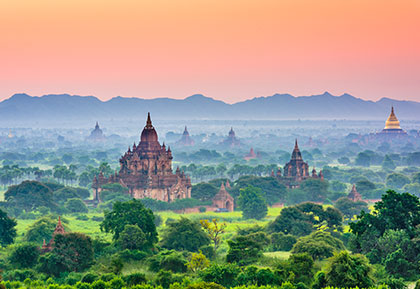
Bagan, formerly Pagan, is Myanmar’s ancient capital and one of the most extraordinary archaeological sites in Southeast Asia. Situated along the banks of the Ayeyarwaddy River, this city sprawls across 42 sq. km and boasts over 13,000 temples, stupas, and pagodas, built between the 11th and 13th centuries. Often compared to Cambodia’s Angkor Wat and Indonesia’s Borobudur, Bagan offers a remarkable glimpse into Myanmar’s religious, cultural, and architectural heritage. Visitors can admire the stunning skyline of temples, explore centuries-old frescoes, and experience the local villages that maintain traditional crafts and ways of life.
Must-See Highlights in Bagan
Bagan is a sprawling archaeological wonder, where thousands of temples, stupas, and pagodas dot the plains. Key highlights include Ananda Temple, a perfectly proportioned masterpiece with four 9.5-meter standing Buddhas and 554 glazed tiles depicting the Jataka tales, and Shwezigon Pagoda, built in 1076 to house a replica of the Buddha’s tooth, featuring a gleaming golden hti. Visitors can also explore Thatbyinnyu Temple, the tallest temple in Bagan offering panoramic views of the plains and river, and Dhammayangyi Temple, the largest in the region, renowned for its fine brickwork and mysterious history. Other notable sites include Shwesandaw Pagoda, famous for sunset views from its elevated terraces; Lawkananda Pagoda, a riverside temple housing a Buddha tooth relic; Bupaya Pagoda, the gourd-shaped stupa on the Ayeyarwaddy River; and Gawdawpalin Temple, a two-storey temple with vaulted corridors and large Buddha images. Cave temples such as Kyauk Gu U Min and Kyanzittha Umin showcase intricate carvings and frescoes influenced by Mongol-era art, while Gubyaukgyi Temple at Wetkyi-Inn and Htilominlo Temple feature well-preserved murals and red-brick architecture.
Villages & Surroundings
The villages around Bagan offer insight into traditional rural life and artisanal crafts. Minnanthu Village is known for bamboo and handicraft workshops, while Phwa Saw Village, the legendary birthplace of Queen Phwa Saw, provides a glimpse into local life. Myinkaba Village is renowned for traditional lacquerware production, and Zee O Thit Hla Village offers authentic experiences with palm sugar and rice farming. A short journey away, Mount Popa & Popa Taungkalat rise dramatically from the plains, serving as the legendary home of Myanmar’s nats (spirits). Mount Popa, at 1,518 meters, offers soft trekking through lush scenery, while Popa Taungkalat perches atop a 737-meter volcanic plug, accessible via 777 steps, providing breathtaking views and spiritual significance.